
How an Australian advisory firm turned proprietary data and on-ground expertise into original research that wins in AI search
As AI makes ordinary content cheap to produce and easy to reproduce, the advantage shifts to original evidence.
This firm turned its own data and market experience into findings its audience could act on and its competitors could not replicate.
At a glance
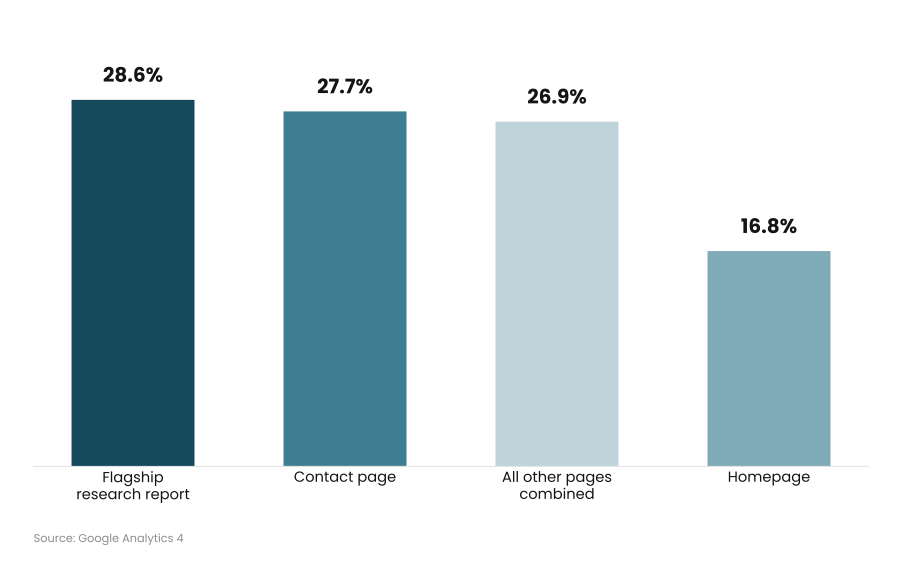
- 28.6% of all site conversions from one page – converting at 4x the site-wide rate
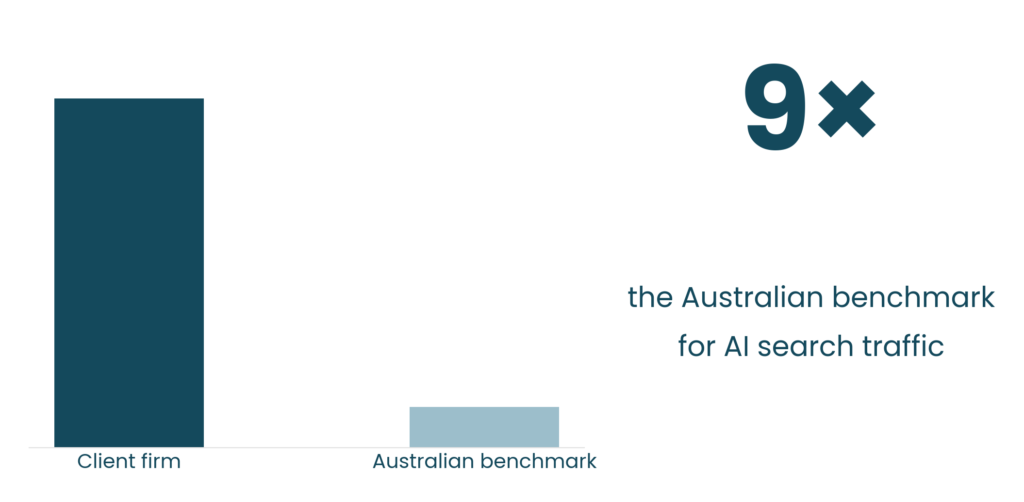
- Site-wide AI traffic at 9x the Australian benchmark
- A third of all AI referral traffic landed on this single flagship report
- Across all traffic sources, the flagship report was the site’s second most-visited page, behind only the homepage
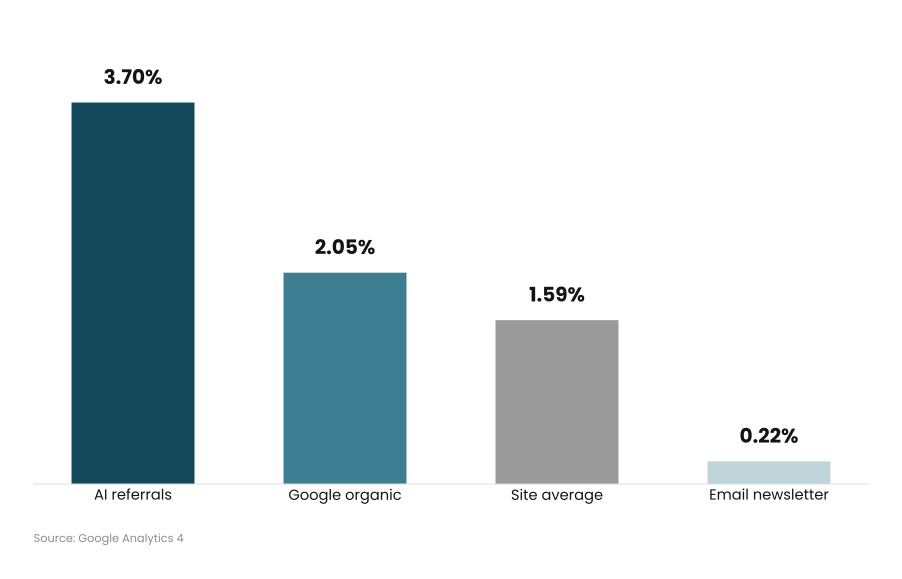
- AI-referred sessions across the website converted at more than 2x the site-wide rate
- The flagship report’s Google organic conversion rate was 5x the channel average
Based on Google Analytics (GA4) data, spanning from the report’s publication on 17 February 2026 to 7 August 2026.
Brand details withheld due to competitive sensitivity.
- The context
- The approach
- Built for discovery and conversion
- The results
- The flagship research report became the site’s most-visited piece of content – and its highest-converting page
- A third of all AI referral traffic went to the flagship research report
- A 53% share of voice across tracked AI prompts
- AI traffic was nearly nine times the Australian benchmark
- AI visitors converted at more than double the site-wide rate
- Dark AI: why visible AI traffic is only part of the picture
- What this means for other businesses
- What could original research establish about your firm?
The context
AI is changing not only how people search, but what businesses need to publish to earn visibility.
People now choose services using AI answer engines like ChatGPT alongside conventional Google search – often moving between the two in a single sitting.
At the same time, generative AI is making generic content cheap to produce and easy to reproduce.
And AI systems already have vast amounts of established knowledge to draw on, increasing the value of sources that contribute something genuinely new.
Together, these shifts move the advantage to original evidence – findings an audience can act on, AI systems can confidently cite, and competitors cannot replicate.
An earlier case study established that AI systems were finding, citing and recommending this property investment firm. The open question was what that visibility produced.
In property investment advice, where clients typically research at length before making contact, being cited matters only if it changes what happens next – which content people reach, how they engage with it, and whether they enquire.
The firm wanted to turn that visibility into something measurable, while building a source that could perform across AI and conventional search.
The approach
The work centred on a single flagship research report, surfacing and synthesising data and industry expertise the firm already held and turning it into original, usable evidence.
The research was designed to do three jobs at once.
Solve real problems for the people the firm wants as clients. Rather than answer generic questions, it addressed specific decisions the firm’s audience was trying to make, drawing on proprietary data and what its advisers were seeing on the ground.
Demonstrate and distinguish what the firm actually offers. The research showed the quality of thinking and analysis a client would be buying rather than simply describing it. Because the evidence came from the firm’s own data and experience, competitors could not reproduce it in the same way.
Contribute something genuinely new to the industry. Original findings give journalists, industry publications, other websites and social channels a reason to report, reference and share the work. That has always helped extend reach and build brand awareness. In the AI search landscape, being linked to and cited by credible third parties takes on even greater importance, establishing the topics on which search and AI systems recognise a firm as an authority.
Built for discovery and conversion
Once the research itself was developed, it was published in two complementary forms.
The web version was built for people and search systems. Using our Dual-Intelligence Architecture, the page was designed to work for human readers, traditional search engines and AI systems at the same time.
The downloadable flagship report gave interested readers a deep, portable version of the research – and asked something in return.
- Value exchange: the research had to be useful enough for readers to willingly provide their details in return for access to the full flagship report.
- Lead capture: those details identified people with a demonstrated interest in the subject.
- Targeted follow-up: the firm could then follow up on the specific topics and problems that had prompted the download.
The results
The flagship research report became the site’s most-visited piece of content – and its highest-converting page
It drew more visits than any page except the homepage – ahead of every service page, article and the firm’s entire back catalogue.
It also generated more recorded conversions than any other page on the website, including the contact page.
Conversions included flagship report downloads and enquiry forms. Across both types, the flagship report accounted for 28.6% of all conversions recorded across the website.
On enquiries alone, it ranked second only to the contact page – ahead of the homepage and every service page – and accounted for 23% of all enquiries.
| Share of all conversions recorded across the website | |
| The flagship research report | 28.6% |
| The contact page | 27.7% |
| All other pages combined (no single page above 5%) | 26.9% |
| The homepage | 16.8% |
Metric | Flagship research report | Site average |
| Conversion rate | 5.9% | 1.59% |
| Engagement rate | 69.8% | 47.1% |
A third of all AI referral traffic went to the flagship research report
AI platforms sent visitors to 20 different pages across the website, including service pages, articles, earlier research, a podcast episode and the education section.
Despite that spread, a third of all AI referral traffic went to the flagship research report. The homepage was next, on just over a quarter.
AI cites specific pages, but often sends traffic to the homepage
That concentration matters because the page an AI system draws on is often not the page that receives the resulting traffic.
Similarweb’s 2026 Generative AI Landscape report found that 65% of the URLs ChatGPT cites sit two or three folders deep within a website. [1]
That pattern became more pronounced during this case study’s reporting period. On 7 May 2026, ChatGPT began turning brand names inside its answers into clickable links rather than footnote-style citations. Similarweb found the share of ChatGPT referrals landing on brand homepages rose from roughly 26–29% before the update to about 62–63% by late May, and has held there since.[2]
The client’s flagship report’s performance is significant in two ways.
First, it bucked the usual homepage bias. On ChatGPT, just under a third of the client’s referrals landed on the homepage – well below the roughly 62% Similarweb observed. Across all AI platforms, the flagship research report was the single biggest destination, drawing a third of referral traffic and more than the homepage.
Second, the pattern suggests a flagship piece of original content can influence AI visibility beyond the traffic that lands on the page itself. AI can draw on that content when forming an answer or recommendation, while sending the eventual visitor to the firm’s homepage or another page on the site.
A 53% share of voice across tracked AI prompts
The page-level result sat within a broader competitive lead.
In July 2026, HubSpot AI visibility tracking gave the firm a 53% share of voice across tracked prompts in its category – more than all the firm’s tracked competitors combined. [3]
Its strongest visibility was on commercial queries, the kind asked by people close to a decision.
AI traffic was nearly nine times the Australian benchmark
From March to July 2026, AI accounted for 2.85% of the firm’s search, social and AI traffic, compared with an Australian benchmark of 0.33% over the same period. [4]
That put the firm’s AI traffic share at 8.6 times the Australian benchmark.
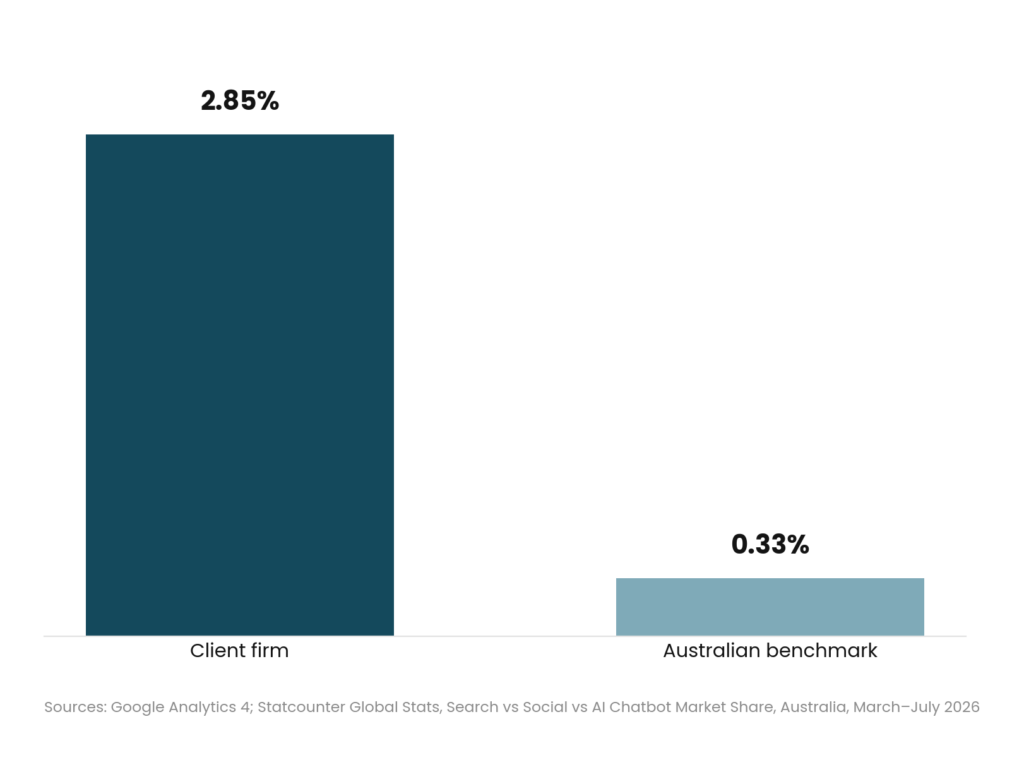
Measurement note: Both calculations exclude direct and email traffic. The firm’s figure uses GA4 sessions; Statcounter’s uses referral page views.
AI visitors converted at more than double the site-wide rate
| Metric | AI referrals | Site average |
| Engagement rate | 55.0% | 47.0% |
| Conversion rate | 3.7% | 1.59% |
The flagship report also became a top performer in Google organic search
The flagship report was the fourth most-visited page from Google organic search, out of 143 pages that received traffic from the channel.
The quality of that traffic was stronger still
| Visitors from Google organic search | To the flagship report | Google organic site average |
| Conversion rate | 10.14% | 2.05% |
| Engagement rate | 87.7% | 59.9% |
Visitors who reached the flagship report through Google organic search converted at nearly five times the Google organic average. The flagship report also generated the third-highest number of conversions from Google organic traffic, behind only the contact page and homepage.
The result points to no trade-off between AI and traditional Google search. The same research asset that attracted outsized AI visibility also became one of the site’s strongest organic-search performers. Its original evidence, clear structure and useful conclusions worked for human readers while also making the research easier for search and AI systems to understand and use.
Dark AI: why visible AI traffic is only part of the picture
GA4 only counts AI when a visit can be clearly identified as coming from an AI platform. If AI shapes the journey but the eventual visit arrives through Google, Direct or another channel, that influence is recorded somewhere else.
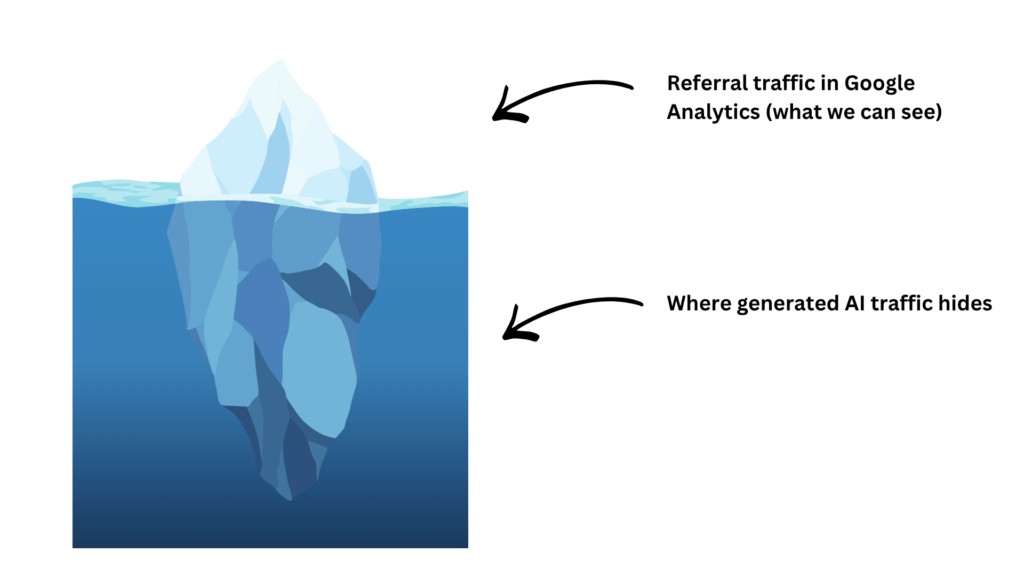
There are three main ways this happens:
- Search rather than referral: Similarweb found that people who received a brand recommendation from ChatGPT were 2.5 times more likely to visit that brand’s website, with 55.9% of AI-influenced visits arriving through search rather than as an AI referral. [5]
- Google’s own AI: clicks from AI Overviews and AI Mode are recorded within Organic Search in GA4 and cannot be separated out. Previsible, which holds one of the largest AI referral datasets available, excludes them from its research entirely, on the basis that AI inside Google’s results almost certainly sends more traffic than every standalone AI platform combined. [6]
- Lost referrer data: links copied out of AI conversations, and visits arriving through AI mobile apps and in-app browsers, often carry no referral data at all and are recorded as Direct.
The firm’s own traffic pattern is consistent with this measurement gap. Direct accounted for 47% of visits to the flagship research report, ahead of 24% from Google organic search, 16% from the firm’s email newsletter, 6% from identifiable AI referrals and 4% from LinkedIn.
We cannot know how much of that Direct traffic was influenced by AI. But it does mean the 6% recorded as AI referrals should not be treated as the full extent of AI’s role in bringing people to the research.
What this means for other businesses
AI referral traffic has grown sixteen-fold in under two years
To see where AI referral traffic is heading, it helps to look beyond this one firm. Across 101,574 websites, AI referral traffic rose from 0.02% to 0.32% of all website traffic between 2024 and 2026 – a sixteen-fold increase in under two years. [7]
The significance is not just the current share of traffic, but the rate of change. AI is becoming a larger part of how people discover and evaluate firms, while the sources, brands and subject associations it draws on are being established now.
Original evidence is the durable advantage
AI can rewrite an opinion, condense a guide or summarise commentary without needing the original source. What it cannot reproduce is a finding that did not exist until someone generated it.
That gives organisations with proprietary data and direct industry experience an advantage generic content cannot replicate. An organisation that publishes what everyone else publishes becomes raw material for AI, and is left uncited. An organisation that contributes something new becomes cited as a primary source.
What could original research establish about your firm?
Most organisations already hold the raw material for original research: proprietary data in their systems and patterns their people see first-hand. Very little of it is ever turned into evidence the market can use.
We help organisations turn that knowledge into original research that gives target audiences something genuinely useful, while giving AI systems and search engines original evidence to find, cite and recommend them.
Find out how your organisation can become a primary source in its category.
Sources
- Similarweb, 2026 Generative AI Landscape report, 22 July 2026. Analysis by Aleyda Solis, Orainti, quoted in the report. https://www.similarweb.com/corp/reports/2026-generative-ai-landscape/ – figures as reported in Search Engine Journal, “AI Referrals Are Recreating The Oldest Mistake In Conversion Optimization”: https://www.searchenginejournal.com/ai-referrals-are-recreating-the-oldest-mistake-in-conversion-optimization/584331/
- Similarweb, “AI Search Stats in 2026,” reporting figures from the 2026 Generative AI Landscape report. Accessed September 2026. https://www.similarweb.com/blog/marketing/geo/gen-ai-stats/
- HubSpot AI visibility tracking, July 2026. Brand visibility monitoring within the client’s own HubSpot account; these figures are not publicly published.
- Similarweb, “The Downstream Impact of AI Visibility,” June 2026. US desktop clickstream panel, July–December 2025, plus a January 2026 survey, across three sectors. https://www.similarweb.com/corp/reports/the-downstream-impact-of-ai-visibilty/
- Previsible, “2026 AI Traffic Report,” 6 July 2026. 166 GA4 properties, November 2024 – May 2026. https://previsible.com/seo-strategy/ai-traffic-report-july-2026/
- SE Ranking, “AI traffic grew 16x from 2024 to 2026,” 18 June 2026. 101,574 websites across 250 countries, January 2025 – April 2026. https://seranking.com/blog/ai-traffic-research-study/