AI is reshaping the front door of every business. More customers are starting their buying journey by asking ChatGPT, Claude, Perplexity, or Google’s AI Mode a question instead of typing keywords into a search bar.
For businesses, the imperative is clear: be visible where your customers are looking. But the nature of this shift matters as much as the fact of it – and behavioural research is starting to reveal that how people respond to AI recommendations isn’t as straightforward as ‘they trust it’ or ‘they don’t.’
The decision-making split
A 2022 behavioural study published in the Journal of Marketing – Artificial Intelligence in Utilitarian vs. Hedonic Contexts: The ‘Word-of-Machine’ Effect by researchers Chiara Longoni and Luca Cian – offers a useful framework.
The researchers coined a term for what they found – the ‘word-of-machine’ effect – framing it as a parallel to traditional word-of-mouth, but one that operates differently depending on the type of decision.
Across nine controlled experiments – including field studies with real consumer choices – they tested how people actually behave when offered AI versus human recommendations. The finding wasn’t that people universally trust or distrust AI. It’s that their response depends on the type of decision being made.
The researchers identified two broad categories, which they label utilitarian and hedonic.
Functional decisions: AI wins
For utilitarian (or functional) decisions – comparing features, evaluating specifications, finding the most cost-effective option – people actually prefer AI over human recommendations.
They see AI as more competent at processing data, weighing trade-offs, and delivering rational, logical evaluations. When the task is “find me the best project management tool under $50 a month,” people trust the algorithm.
Experiential decisions: humans win
For hedonic (or experiential) decisions – choosing a restaurant for a special occasion, picking a holiday destination, selecting a gift – people resist AI and prefer human input.
They believe humans are better at understanding taste, emotion, and the subjective qualities that make something feel right. When the task is “where should I take my partner for our anniversary,” people want a recommendation from someone who gets it.
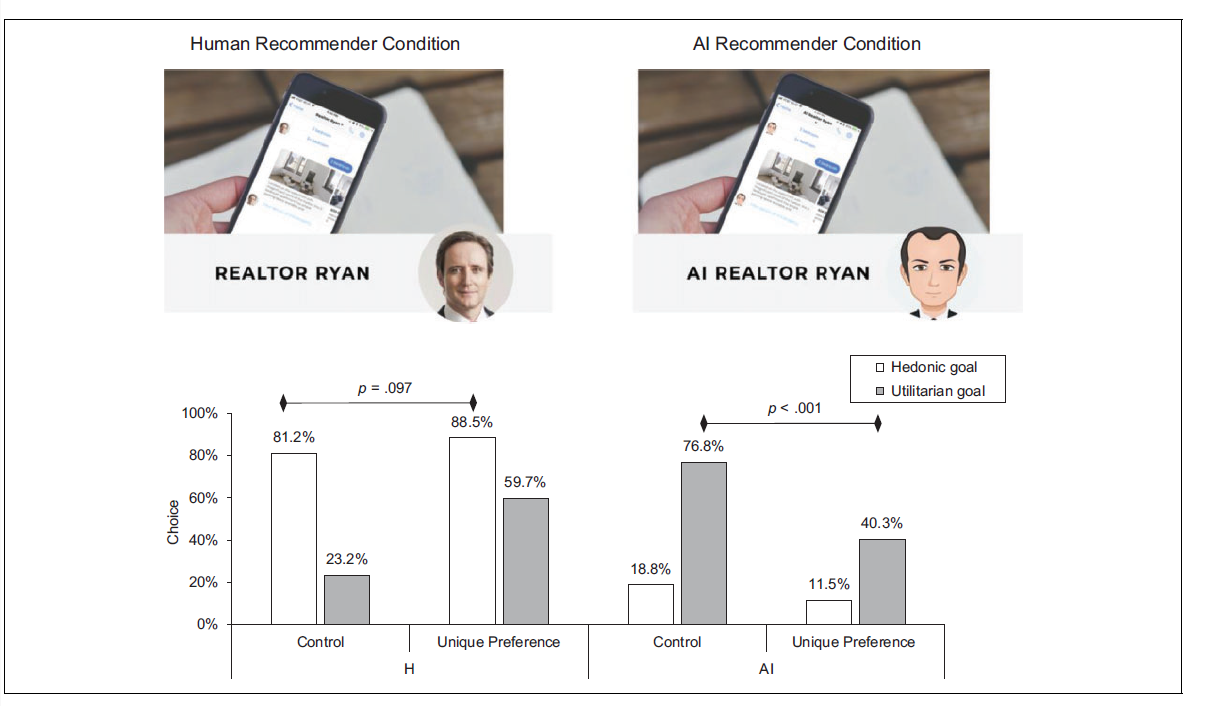
For experiential ones, 81.2% chose the human. The pattern held across all nine experiments, with the size of the split varying by context.
(Longoni & Cian, 2022)
What this means for service businesses
If your business answers functional queries – accounting, financial planning, legal services, software, insurance, professional services, consulting, recruitment, IT, logistics – your customers are increasingly comfortable discovering you through AI.
They’ll ask an AI search engine “what’s the best accountant for small businesses in Melbourne” and trust the shortlist that comes back. Your job is to be on that shortlist. That’s where AI visibility and search strategy matter most right now.
But personalisation changes things
The researchers found an important behavioural boundary. Even within functional decisions, the moment the recommendation needs to match someone’s unique personal situation, trust in AI drops sharply. People are comfortable with AI for broad category evaluation – “what are the best options?” – but want a human for personalised guidance – “which of these is right for me?”
AI opens the door, humans build the trust
That maps neatly onto the customer journey. AI dominates discovery and shortlisting. But once decisions become personal or subjective, the study found people consistently preferred human recommenders.
In the new online environment, this preference translates directly to the human signals customers look for as they move deeper into their decision – content that demonstrates real experience through expert opinions, original insights and research, testimonials, and case studies, as well as human touchpoints at strategic stages in the buyer journey.
These are the trust signals that carry a customer from shortlist to conversion, and they work precisely because they carry the weight of human judgment that this research shows people still value.
What about experiential businesses?
AI as a partner, not a replacement
Even if your product is more emotional than functional – hospitality, food, lifestyle, luxury – AI isn’t irrelevant to your customer journey.
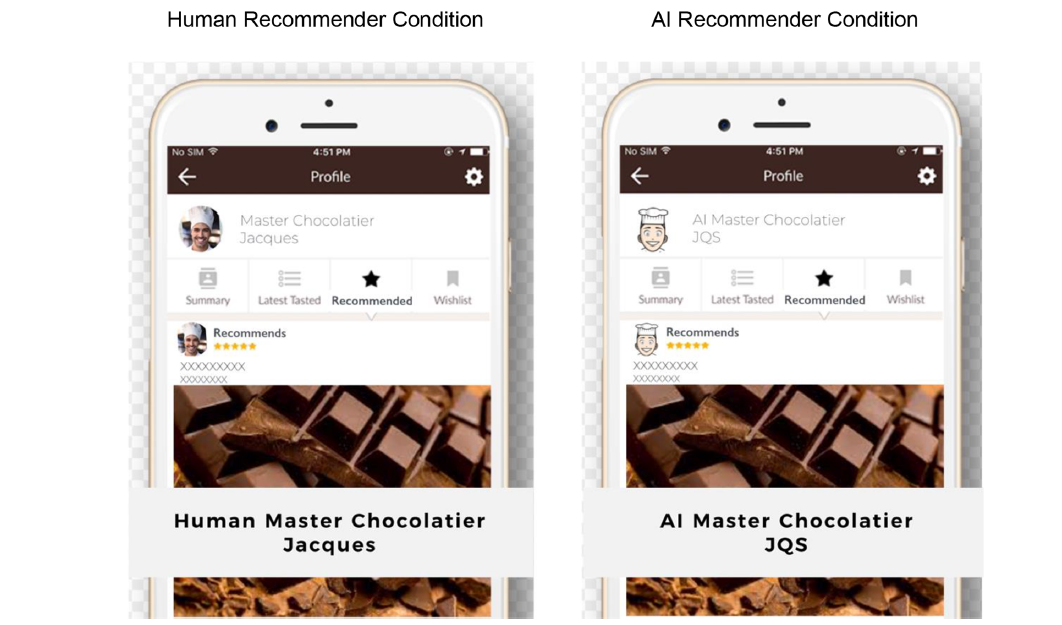
One of the study’s most practically useful behavioural findings was that when AI is framed as augmenting a human rather than replacing them, resistance disappears. A chocolate selection from “our master chocolatier, supported by AI-powered flavour matching” lands very differently from “selected by our algorithm.”
The human stays central. AI makes them better. That’s a positioning and content strategy as much as a technology decision.
(Longoni & Cian, 2022)
The fundamentals beneath the hype
This research was published before ChatGPT launched and AI usage exploded. Attitudes have undoubtedly shifted since then – people are more comfortable with AI across the board than they were in 2022, and that comfort will only grow.
But what this study reveals is the fundamental structure beneath those shifting attitudes. The split between functional and experiential isn’t about technology adoption – it’s rooted in deeper cognitive beliefs about what machines are and aren’t competent to judge.
As people become more familiar with AI, the boundaries will move. But understanding where those boundaries sit – and why – is what allows businesses to stay ahead of them.
Where does your business sit?
The question for most businesses isn’t whether AI matters to their customer journey.
It’s whether the content you have today is structured clearly enough for AI to explain who you are and why you’re a fit for your target customer.
See how this applies in practice – read how one Australian advisory firm grew AI search traffic 1,164% while building the human trust signals that convert.